August 10, 2026
A wedding portrait should never feel like a pause button on the celebration. The most beautiful images hold the feeling of the day: the quiet anticipation before the ceremony, the relief of finally being together, the laughter that arrives when you stop trying to look perfect. These wedding photo posing tips are designed to help you feel refined and confident without losing the natural connection that makes the photographs unmistakably yours.
The goal is not to memorize a series of stiff positions. It is to create flattering shape, beautiful light, and enough ease that real emotion has room to appear. A thoughtful photographer will lead that process gently, so you can remain present with each other and with the people who have come to celebrate you.
The most convincing portraits begin when you treat one another as the focus, not the lens. Before looking toward the camera, take a breath, settle into your partner, and let your attention land somewhere familiar: their hands, their expression, the small detail of their outfit you have been waiting to see all day.
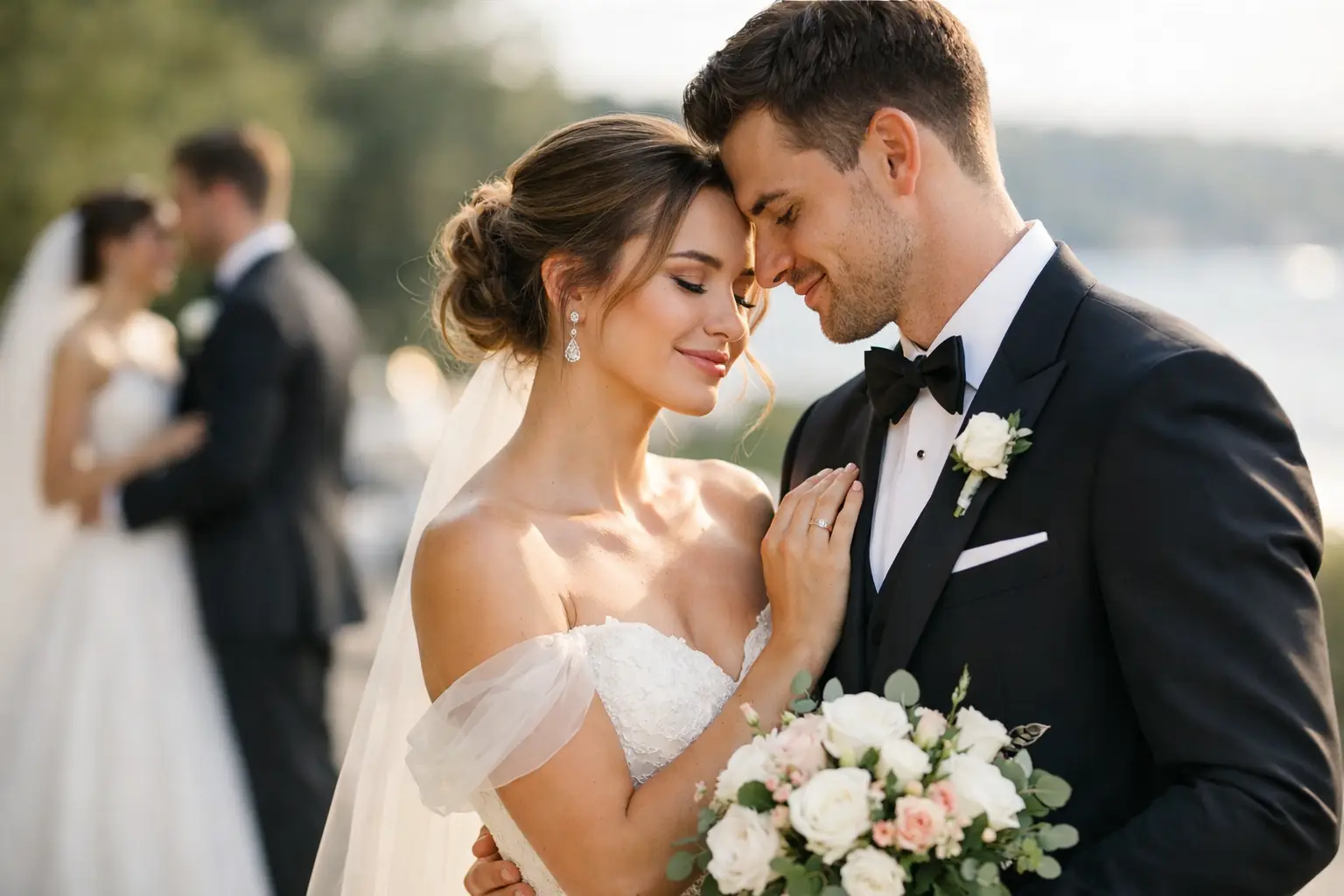
Stand close enough that your bodies feel connected. A small space between you can read as uncertainty in a still image, while a hand at the waist, a shoulder leaned gently inward, or foreheads nearly touching creates immediate warmth. You do not need to force a dramatic moment. Simply giving each other your full attention often creates one.
If direct eye contact feels intense, look at your partner’s cheek, collarbone, or hands. These quieter points of focus can feel more natural and photograph beautifully. Then, when the photographer asks you both to look toward the camera, your body language will still carry the closeness of the moment.
Flattering posing is usually less about changing how you look and more about avoiding a flat, front-facing stance. Cameras translate dimension differently than the eye does, so subtle adjustments can make a meaningful difference.
Rather than facing the camera with both shoulders and feet parallel, turn your bodies slightly toward each other or at a soft angle. Shift your weight onto one leg and let the other knee relax. This creates movement in the silhouette and keeps your posture from looking formal in the wrong way.
For couples, a simple arrangement works beautifully: one person angles their torso toward the other, while the other stands just a touch behind or beside them. The result feels editorial but still intimate. Your photographer may refine the placement of your feet, hips, or shoulders. These small adjustments are not about correcting you. They are what allow a natural moment to translate into an elegant frame.
Hands can feel surprisingly awkward when they have nowhere to go. Instead of letting them hang at your sides, use them to create a point of connection. Hold hands loosely, place one hand at a waist or lapel, smooth a veil, touch the edge of a bouquet, or rest your fingers lightly along your partner’s arm.
Keep the hands relaxed. White-knuckle grips and overly spread fingers can read as tension, especially in close-up images. Think of a soft touch rather than a pose. If you are holding a bouquet, keep it near the natural waist rather than high against the chest, where it can hide the lines of your attire.
A gentle lengthening through the spine photographs well, particularly in formalwear. Imagine your head being lightly lifted from the crown, then let your shoulders fall away from your ears. This gives you poise without the strained feeling of forcing your chest forward.
Good posture is especially helpful during ceremony exits, first looks, and portraits in structured gowns or tuxedos. Still, it should never override comfort. If a pose makes you feel unlike yourself, say so. The right adjustment should support your confidence, not make you feel performed.
Some of the most cinematic wedding photographs happen between poses. Walking slowly together, adjusting a veil in the breeze, sharing a private comment, or turning toward one another after a kiss all create images with life in them.
Movement is also helpful for couples who feel nervous in front of the camera. Instead of asking, “What do I do with my face?” you have a simple action to follow. Walk toward the photographer at an unhurried pace, look at each other, and let yourselves smile when something genuinely amusing happens. The photographs will feel less like a portrait session and more like a memory unfolding.
There is a trade-off to consider. Movement takes a little more time than a still, composed portrait, particularly with a long train, intricate veil, or crowded venue. Build a few unhurried minutes into the timeline for both. Begin with the polished, frame-worthy portrait, then make space for the candid motion that brings your gallery to life.
Your wedding design can give your hands, gaze, and body a natural place to go. A sweeping staircase, an arched doorway, a garden path, or a window with soft light can shape a portrait without making it feel overly styled. The architecture and atmosphere should support the image, not compete with you.
At a Dallas ballroom wedding, for example, a quiet moment beside tall windows may offer a more timeless result than posing in the center of a busy reception room. At a destination celebration, the view may be part of the story, but the strongest image still keeps your connection at its center. It depends on what you want the photograph to hold: the sense of place, the fashion, the emotion, or all three in balance.
Accessories can add movement and intimacy as well. Let a veil fall naturally behind you, then have your partner gather it gently. Hold your jacket over one shoulder during a late-evening portrait. Bring your bouquet close for one image, then set it aside for another. Variety comes from subtle changes, not from reinventing the pose every few seconds.
Family photographs ask for a different kind of posing. Here, the priority is clarity, flattering arrangement, and preserving the significance of having generations together. A skilled photography team will organize groupings efficiently, place taller guests where they balance the composition, and make sure faces are visible.
Your role is simple: stay close, relax your shoulders, and keep your attention near the photographer unless you are prompted to interact. Avoid pressing your arms tightly against your body or leaning too far away from those beside you. A slight angle and a comfortable point of connection, such as an arm around a parent or a hand held with a grandparent, will make the image feel both polished and affectionate.
For a luxury wedding day, preparation protects the experience. Share your family portrait list in advance, designate someone who knows key relatives, and reserve enough time that no one feels rushed. The calm behind the camera is visible in the final image.
You do not need a rehearsed routine. In fact, trying to replicate every pose from a saved inspiration image can make couples feel self-conscious. But an engagement session is a valuable opportunity to understand how you naturally stand together, how you prefer to be directed, and which expressions feel most like you.
If you are not planning an engagement session, take ten quiet minutes at home. Stand together in front of a mirror, practice a relaxed handhold, and notice how it feels to turn slightly inward. The purpose is familiarity, not perfection. On the wedding day, that small sense of familiarity can make it easier to settle into the moment.
Share any concerns with your photographer beforehand. Perhaps you feel unsure about your profile, have a favorite side, are wearing a garment with limited mobility, or want to protect a carefully constructed hairstyle. Professional guidance should be personal, never one-size-fits-all.
A veil may catch the wind. Someone may laugh halfway through a kiss. Your partner may whisper something that makes you look away from the camera with an expression no pose could produce. These are not interruptions to the portrait experience. They are often the images you will return to decades from now.
Beautiful wedding photography is not built on flawless stillness. It is built on trust, thoughtful direction, and the freedom to be fully together. When you choose comfort over performance, the photographs become more than polished images. They become authentic moments, artfully preserved for the people you are today and the family who will one day inherit your story.